Weight Space Programming
When an LLM writes the weights
Vizuara is not affiliated with the authors of the article. The idea and the released edit are theirs. Our studies, and any mistakes in them, are ours.

 Vizuara AI Labs
What if a model could edit another model’s weights?
Dr. Raj Dandekar
Co-founder, Vizuara AI Labs · PhD, MIT
Build a DeepSeek Model (From Scratch)
One post, 9.7 million views in four days
| 2 Nov | Four MIT CSAIL researchers publish Sparks of Weight-Space Programming. Their claim: LLMs can “natively read/write neural network weights”. |
| 2 Nov, later | The first reproduction and the first pushback both appear within hours. |
| 3 Nov | Hugging Face reproduces the edit, Simon Willison tries part of it on a laptop, The Register covers it, and Latent Space’s AI News makes it the headline. |
| 4 Nov | People start editing their own models. |
| 5 Nov | The term already has a Wikipedia page. |
Why this one spread: it sounds like the end of gradient descent.
Ask an LLM for the weights. Skip the training.
It reads a network
GPT-6 Astra sees 17,253 raw numbers and is asked which game the network was trained on. It names all four games, with no options given.
It writes a network
It writes a Breakout network in one reply: no data, no training. It scores 517.4. PPO after 500 million steps scores 25.3.
It edits a network
It changes 0.016% of the weights of Qwen3.5-0.8B, an open model. Its MATH-500 score goes from 7.9% to 48.1%, with no training.
All three as reported by Takehi, Teoh, Zhang and Khattab, MIT CSAIL, 2 November 2026. The authors call these results “sparks” and very early.
Small arcade games, played on a 10 × 10 grid
Breakout
Move the paddle so the ball bounces back and breaks the bricks.
Seaquest
Steer the submarine, rescue divers and avoid the enemies.
Asterix
Move between lanes, collect gold and dodge the enemies.
Animations drawn for this slide in the MinAtar style. This is not the network playing. The network sees only such a grid, as 600 numbers.
Within three days, people tried it on everything
| Who | What they did | What happened | Likes |
|---|---|---|---|
| @AlexKrentsel | Reran it across model generations | A sharp jump in the latest models: Breakout up to 22× the RL baseline | 7.8K |
| @jacsebl | Had Fable hand-write a 100K-parameter legal citation checker | 97.8% with no labels against 94.6% for training on 8,192 labels, self-reported | 7.7K |
| @simonw | Tried reading weights with Qwen 3.8 27B on a laptop | Named 3 of 4 games, about an hour each. It missed Freeway | 5.4K |
| @NielsRogge | Reproduced the Qwen edit at Hugging Face, using ML Intern | Released the model and a demo you can try | 1.6K |
| @HaozeHe_Hector | Edited 1,024 weights of NanoJev, which plays Tank War | Beat the original 65 to 34. It fires more often, and it does not aim better | 60 |
| ValerioDolci | Had Opus 5.5 edit 8 neurons in Gemma 4 12B to change one Italian tense | 182 of 200 unrelated translations unchanged, as reported on Reddit and GitHub |
Notice the variety: games, law, translation. Also notice who reports the numbers. Almost everything here is a single self-reported run.
The same day, the careful readers arrived
| Who | Their point |
|---|---|
| @NeelNanda5 | Read it as Astra doing classic mechanistic interpretability very well. Such methods have struggled to scale to real LLMs. |
| @giffmana | The prompt hints strongly that looping is the issue. Without looping to fix, it could not improve math. |
| @paul_cal | The toy results are real, but the big claims lack good baselines, and the Qwen result is a bug fix. |
| @AlexKrentsel | The Breakout network has 20,486 parameters. Frontier models have around a trillion. |
| @ravfogel | Is it mostly reading the first and last layers, the ones tied to known inputs and outputs? |
| @voidxtrain | From the logs: finish rate 7% to 65%, while accuracy on finished answers fell from 93% to 71%. |
Gemma 3 270M rarely loops. Their edits moved its math score by about one point.
From raw weights alone, Astra could not tell which of two models was sycophantic, in all four attempts.
It could remove an obstacle that hid an ability. It could not add an ability the model lacked.
A weight is a number. Normally, nobody writes it.
Read a network. Fix a network. Write a network.
Raw weights only, no tools. It names the game the network was trained on.
A car stalls on a ramp. It edits 3.5% of the weights, in one reply.
Breakout from zero. Score against PPO after 500 million steps.
Where it failed: it could not spot a sycophantic model from weights alone, and it gave Gemma 3 270M no real gain. On language models it worked with Python and test runs.
Astra writes a Breakout network, number by number
Before, the edit, and after: the same question
One direction keeps the model going round
h is the model’s hidden state and v is the repetition direction. The edit removes the part of h that points along v. Token counts are the real two-train run. The 2D picture is a schematic: the real space has 1,024 dimensions.
Three questions the hype skips
What is a written network worth?
Count the labelled examples normal training needs to match a network written with no data.
What does an edit cost?
If you turn down what makes a model repeat itself, can it still copy when you ask it to?
Does the gain compound?
One gain says nothing about a loop. So we looked for the second gain.
Fable, Opus and Sonnet wrote the networks. Claude agents ran the studies overnight under a written charter, at $741.60 of Modal in total. Credit to the authors for releasing their edit and logs.
The same trick is worth 12 examples, or more than 10 million
| The task | Written, no data | Training catches up after |
|---|---|---|
| Name the clothing in a small photo | 47.7% | 12 examples |
| Read a handwritten digit | 60.2% | 25 examples |
| Say which of 50 languages this is | 92.7% | 437 examples |
| Check a 12-digit Verhoeff checksum | 100% | not after 10 million |
If you can say the rule in words, an AI can write it into a network.
Medians of 15 networks by Fable, Opus and Sonnet. The models were given the Verhoeff rule and tables, and did not discover them. “Not after 10 million” means our training did not learn it, not that no training ever could.
Each panel shows one typical network, so its crossing can differ a little from the table.
How does a computer catch a typing mistake?
A checksum check that was never trained
Now the real network. Press a digit to change it.
Written by Opus with no examples, and never run before it was scored. It was given the rule and its tables.
The rule is a board game with 10 squares. Each column is one digit read, from right to left, and the lit cell is where you are. 100 AND units, the same unit as before, do the moves. Finish on square 0 and the number is valid.
Which language is this sentence?
A language detector, from memory
Written by Sonnet: for each language it recalled about 150 to 250 words, counted the letter patterns, and stored the counts as one table of 50 × 1,024 numbers.
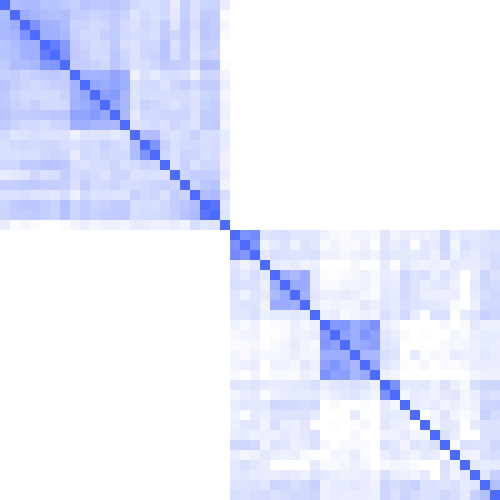
Each square compares two languages’ rows of weights, ordered by family. The dark blocks are language families, and nobody asked for them.
Pictures have no rule. Watch what happens.
Draw a digit with the mouse.
47.7% overall. Trousers and sneakers have distinctive shapes. Coats, pullovers and shirts look like the same block, and end up called bags.


The edit does forget. One specific thing.
What forgetting looks like: real answers from Qwen
1,fable,xenon,active1,fable,xenon,active 2,fable,xenon,active 3,fable,xenon,active 4,fable,xenon,active 5,fable,xenon,active
1,fable,xenon,active
2,cat,argon,active
3,dog,neon,active
4,bird,hydrogen,active
5,snake,ion,active
It was told to change only the number. It started inventing other values.
84
85
86
...
131
132
133
84
85
86
...
111
112
113, and then it stopped
It stopped 20 numbers early, with no sign that anything was wrong.
478
479
480
481
482
(478 is missing)
479
480
481
482
It skipped the first number.
27. Varun, age 76: Tab. Losartan 50 mg, twice a day, for 24 days.
27. Varun, age 76: Tab. Losartan 50 mg, twice daily, for 24 days.
The meaning survived here, but it was told to copy exactly and it reworded a medicine instruction.
We picked these because they are easy to read, so they are not typical. On 25 ordinary documents, it copied 22 exactly before the edit and 21 after. The damage shows up in structured data and long copies. If your model writes reports, you may never notice. If it moves JSON or code all day, test first.
What it kept, and why the authors are still right
Up and to the left is good. Normal training here is one simple recipe with no safeguards, so a careful engineer would do better.
The first gain was 42.8 points. The second never came.
Math score on a test no agent saw. A failed attempt stays in the data as a flat step. One chain has no round 3, because that run did not happen.
It translates. It repairs. It has not yet compounded.
| What the hype says | What we measured |
|---|---|
| LLMs replace training | Where the rule can be said in words: 100% on a checksum training never learned. Where it cannot: worth about 25 labels. |
| A tiny edit has no cost | Exact copying falls 13.4 points, far past any random edit. Knowledge, languages and refusals hold. Much better than our training recipe. |
| This is how recursion begins | 0 of 11 second gains from the edited model, and no clear benefit from choosing its own edits. Our budget was small, so this is not a proof. |
It is real, and it is narrower than the headline.
Can it discover a rule, or only translate one that it was given?
Does any of this work on a model with no single bug to fix?
Does it survive the step from a billion weights to a trillion?
All of it is open to read and check
If this made you want to run your own study, that is what we do in the Research Assisted Bootcamp for Inference Engineering, where I mentor each paper personally. It runs to 1 January 2027. The early bird of ₹95,000 ends tonight at 11:59 PM IST, and it is ₹1,25,000 after that.
Who made this. Dr. Raj Dandekar and the team at Vizuara AI Labs. Agents ran the experiments under a written charter. We teach with love, care and passion, and we would like to hear what you find.